Las Rotes: living on the rocky coast
Las Rotes is Jávea's quiet rocky-coast pocket — high-end villas and sea-view apartments above crystal snorkelling coves, with no sand and no intention of apologising for it. It suits swimmers, snorkellers and peace-seekers who want the water itself, not the beach scene around it.
The character
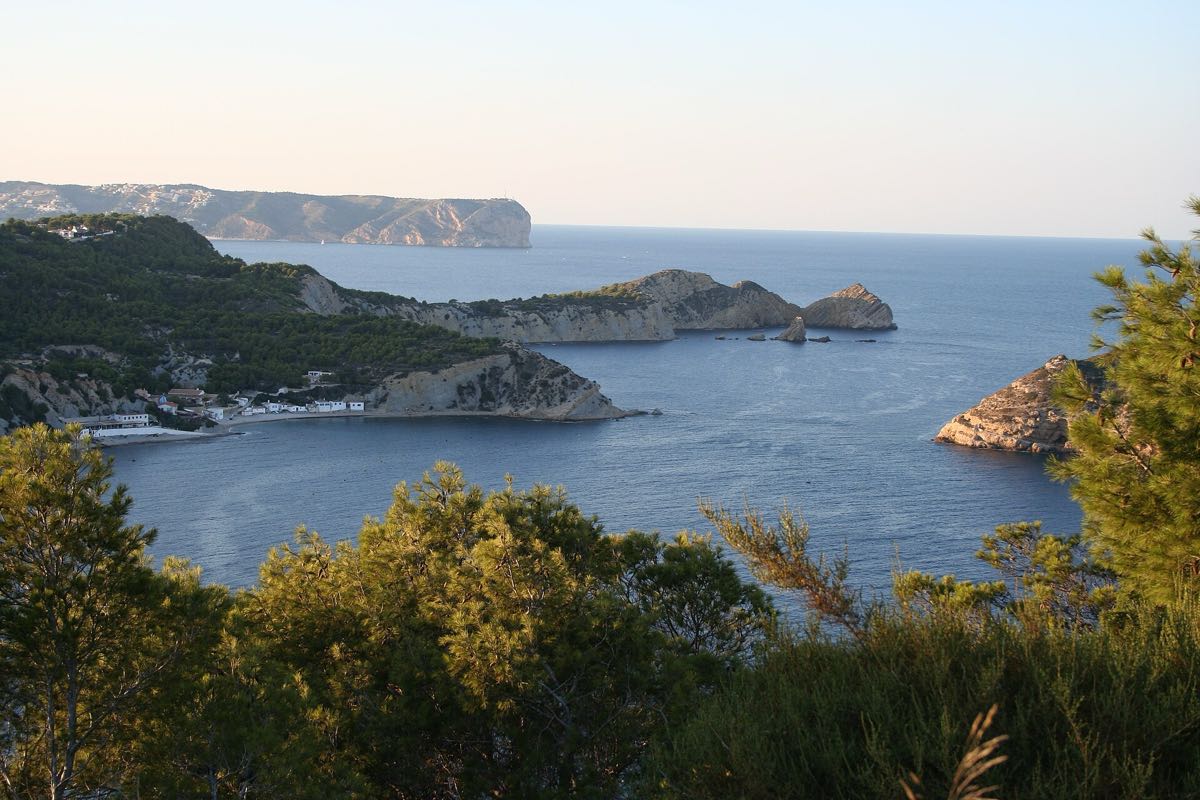
Las Rotes is Jávea's quiet rocky-coast pocket — a high-end scatter of villas and sea-view apartments above some of the clearest snorkelling water on this stretch of the Mediterranean. There is no sand, no rank of loungers, no bar with a laminated menu; there are sunbathing rocks, pine-shaded lanes and coves — Cala Blanca among them — where the water is transparent enough to make you doubt its depth. The Cap Prim and Portitxol headlands supply the backdrop, the old town sits a short drive inland, and the whole zone runs on a lower pulse than the Arenal. People here do not go to the beach; they go for a swim. The distinction, it turns out, matters.
A note on the name
One clarification before anything else: there are two rocky coasts called Las Rotes on this bay, and they belong to different towns. Dénia has its own celebrated Les Rotes strip a few kilometres up the coast; this guide covers Jávea's Las Rotes — the Cala Blanca and La Barraca side, on the northern edge of the town's coastline. Estate listings occasionally blur the two, which is worth catching early, because while the geology is similar the logistics are not: Jávea's version puts you a short drive from Jávea's old town, port and international school rather than Dénia's. Check the map, not just the name, and you will save yourself a confused viewing trip.
The water
The zone's entire argument is the water. Cala Blanca is the flagship — a rocky snorkelling cove where fish drift over pale stone in improbable clarity — and La Barraca and Cala Sardinera continue the theme along a protected shoreline that development largely left alone. Because the coves are rock rather than sand, nothing churns; visibility that other resorts advertise as an excursion is here simply the view from your towel. Masks and fins live by the front door the way umbrellas do in other climates. If your idea of coastal living involves actually being in the sea most days, rather than beside it, this is the strongest candidate in Jávea.
No sand — and why that is the point
Let us be honest, because the zone is: there is no sandy beach in Las Rotes, and anyone who needs one daily should buy near the Arenal instead. What the rocks give in exchange is considerable. The water stays clear because there is no sand to stir; the coves stay quiet because there is nowhere to plant five hundred umbrellas; and the shoreline keeps a wildness that groomed beaches surrendered decades ago. Residents develop a connoisseur's knowledge of which flat rock catches the morning sun and which ladder gets you in without ceremony. The sand, when the mood strikes, is a short drive away — which most here find is precisely far enough.
Homes over the water
The stock splits two ways: detached villas on the lanes above the coves, and sea-view apartments that put the Mediterranean on the other side of the glass for less money and less maintenance. Roughly four homes in five catch a sea view — among the highest likelihoods in Jávea — and the pricing sits at the upper end of the town's mix, as a protected shoreline with almost no room for new supply tends to ensure. The apartment option deserves emphasis: it is one of the few places in Jávea where lock-up-and-leave living comes with genuinely front-row water, which makes it popular with buyers who split the year between countries.
The daily logistics
Las Rotes is car-light rather than car-free. The nearest supermarket sits a couple of kilometres away, the old town about four, and the port and marina — with their restaurants and year-round working life — closer still, at roughly three. The international school is a manageable run of about six kilometres, and the hospital a longer but unremarkable drive. Walkability scores around 35/100: within the zone you stroll to the coves and along the shore path happily, but errands mean the car. It is the classic Jávea trade — you accept ten minutes of driving in exchange for waking up somewhere no commercial strip would ever be allowed.
The year-round swimmers
Every zone in Jávea has its tribe, and Las Rotes belongs to the year-round swimmers — the residents who are in the water in December with a fortitude that borders on the theatrical. The sheltered coves and rocky entries make winter swimming more practical here than on the open beaches, and a genuine culture has formed around it: the same faces at the same ladder, the post-swim coffee, the mild competitive understatement about the temperature. It gives the zone something most second-home coasts lack — a visible, sociable off-season life conducted at the water's edge, twelve months a year.
Every coast has its faithful. Las Rotes has the December swimmers — and once you have joined them, sandy beaches start to feel like a compromise you used to make.
The Coastal Record
Who it suits
Swimmers and snorkellers first, obviously — anyone whose daily happiness correlates with time in clear water. Beyond them: buyers who want front-row sea without front-row crowds; apartment purchasers seeking a lock-and-leave with a genuine view; and quiet-seekers who find the Arenal's summer energy exhausting rather than energising. It suits couples and independent older buyers particularly well. It suits less well: families who need sand and shallow water for small children every day, anyone who wants bars and shops within strolling distance, and buyers for whom a beach club is part of the dream. Las Rotes has no beach club. Las Rotes regards this as a feature.
Las Rotes against its rivals
Against the Arenal, Las Rotes trades sand, promenade and walk-to-everything for clear water, quiet and a better view per euro. Against Cap Martí and Portichol, its nearest kin in spirit, it offers a gentler coast and easier access to the port side of town, where the Portichol fringe climbs higher for bigger drama. Against the Montgó hillsides, it is the difference between living above the sea and living in it. The honest sorting question is single: how often will you actually swim? Daily swimmers belong here; weekly swimmers may find the Arenal's convenience wins; view collectors should look at the headlands.
Buying here
The buying questions are those of any mature rocky-coast pocket. For villas: how the plot actually reaches the water or the shore path, the age and renovation history of the house, and what the terraces make of the view. For apartments: the state of the community, the fees, and which orientation the block gives you — front-line east-facing glass is the prize. Supply is structurally tight, because the protected shoreline forbids meaningful new development; that scarcity supports values but demands patience from buyers with a precise brief. Directionally, expect to pay a premium over comparable inland stock, and expect it to be justified every morning.
Raske svar
Is there a sandy beach in Las Rotes? No — and the zone is refreshingly unapologetic about it. The coast here is rock, coves and swimming ladders, with Cala Blanca the best-known entry point. The compensation is exceptionally clear, quiet water. When sand is required, the Arenal's broad beach is a short drive away.
Can you really swim year-round in Las Rotes? A committed local contingent does, helped by sheltered coves and easy rocky entries. Winter water is bracing rather than comfortable — this is the Mediterranean, not the Caribbean — but the culture is real and sociable. Most residents manage a far longer season than they ever expected, which is rather the zone's quiet gift.
Do I need a car in Las Rotes? For errands, yes. Walkability is about 35/100 — you stroll to the coves and the shore path, but the supermarket is a couple of kilometres away, the old town about four and the port roughly three. It is car-light living: short, easy drives rather than genuine walk-to-everything.
Businesses & distances in Las Rotes / Cala Blanca →
Places in this guide

Slesta Advisor
★ 5 (6049 anmeldelser · 2026-06-07)

Aventura-T Kayak en Jávea
★ 5 (344 anmeldelser · 2026-06-07)

The Vets Jávea
★ 5 (291 anmeldelser · 2026-06-07)

Atina
★ 5 (183 anmeldelser · 2026-06-07)
Redwood Solar S.L.
★ 5 (110 anmeldelser · 2026-06-07)

Vive Jávea
★ 5 (88 anmeldelser · 2026-06-07)