The La Plana windmills walk: an easy plateau route with two bays in view
The windmill route across La Plana is the Montgó's easy sibling — flat plateau walking past old stone mills to one of the most generous viewpoints on this coast. The route, the best hour for it, and why the town watches the day end from here.
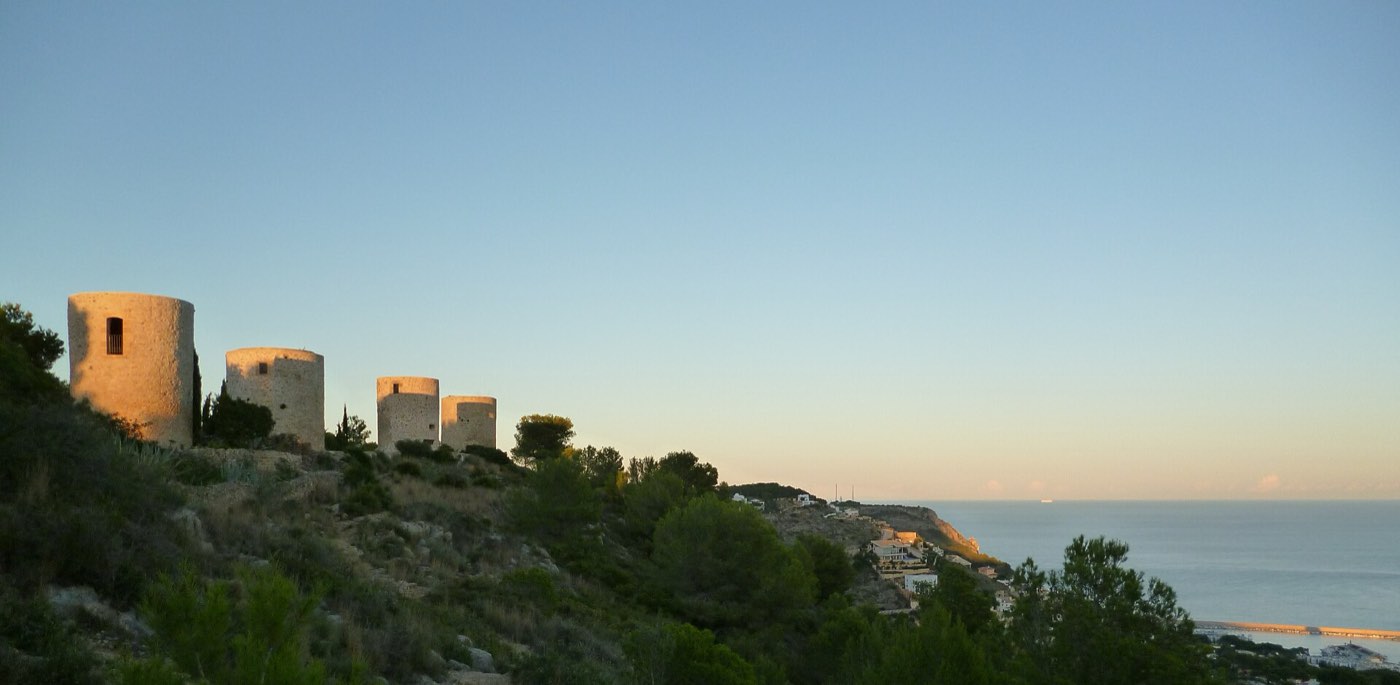
The mountain's gentlest introduction
Jávea's walking reputation is built largely on the Montgó — a genuine 753-metre undertaking with sharp limestone and real exposure — which makes it easy to overlook that the same massif has an entirely different side to offer. The La Plana plateau, on the lower ground toward Dénia, carries a flat, easy route past a row of old stone windmills that delivers one of the most generous views on this coast for almost none of the effort the summit demands. It's the walk to give someone who claims not to like walking, or to save for the evening after a harder day elsewhere.
Where La Plana sits and what's there
La Plana is the ridge of relatively flat, elevated ground running between Jávea and Dénia, on the Montgó's lower flank rather than its summit. The route's centrepiece is a line of old stone windmills — restored and still standing, weathered by centuries of coastal wind — set along the plateau with open views in more than one direction at once. Unlike the summit trail, none of this demands technical footwear or a full-day commitment; it's a walk that fits comfortably into an evening.
The route, roughly
The core stretch past the windmills follows flat plateau paths and quiet access lanes, with the ground itself posing none of the Montgó summit's difficulty — this is walking terrain, not scrambling. Expect open, largely shadeless ground throughout, which matters more for sun exposure than for underfoot difficulty. The route has more than one access point, so it's easy to walk a shorter stretch if that's all the time allows, or extend it along the ridge for a longer outing.
Easy underfoot, exposed overhead
This is a genuinely easy walk by any standard — flat to gently undulating, on established paths and lanes, walkable in ordinary trainers rather than technical boots. The one thing worth taking seriously is the sun: there's very little shade across the open plateau, so what the route lacks in physical difficulty it makes up for in exposure on a hot afternoon.
Best time to walk it
Late afternoon into early evening is the route's best-known slot, and for good reason — the windmills catch the low sun beautifully, the plateau's open aspect gives an unobstructed view as the light turns gold, and a well-timed finish puts you in position for sunset over open ground with genuinely little competition for the view. Morning works too, with the advantage of cooler temperatures if you're walking through the warmer months, though the light is generally considered less dramatic than the evening slot.
Walking the route, start to finish
A simple approach for a first visit:
- Choose an access point — several lead onto the plateau, so pick whichever suits where you're starting from
- Carry water and sun protection regardless of how short the walk looks — shade is genuinely scarce
- Walk the full windmill row rather than stopping at the first one — the view shifts meaningfully as you move along the ridge
- Time your visit for late afternoon if sunset is the goal, and arrive with time to spare rather than rushing the last stretch
- Bring a torch or phone light for the walk back if you're staying for sunset — the light fades quickly once the sun's down
Parking and access
The plateau has multiple access points rather than a single trailhead, which means arriving early isn't as critical here as at some of the coast's more famous viewpoints — if one approach looks busy, particularly around sunset, another access point along the ridge is usually a short drive away. That said, the most popular sunset slot does draw a small crowd on a clear evening, so building in a little patience or flexibility around exactly where you park is sensible.
Combining it with the rest of the Montgó
For anyone already spending a day on the Montgó's harder routes, the La Plana windmills make a natural, low-effort finish rather than a full outing on their own — a way to end a demanding day with almost no additional physical cost. Equally, it works perfectly well as a standalone evening walk that has nothing to do with the summit at all, which is exactly the point: this is the Montgó's easiest face, not a lesser version of the same challenge.
What to bring
Water and sun protection matter more than the modest walking demands the route makes — there's very little shade across the open plateau, and an evening walk in warmer months can still catch real heat before the sun properly drops. Ordinary trainers or comfortable shoes are entirely adequate; nothing about the terrain calls for hiking boots. A light layer is worth having for a lingering sunset stop, since the breeze picks up once the sun's gone.
Quick answers
How long does the La Plana windmills walk take? The core stretch past the windmills is comfortably walked in under an hour at an unhurried pace, though the exact time depends on which access point you start from and how long you linger at the viewpoints — treat any duration as approximate rather than fixed. It's easily extended along the ridge for a longer outing, or kept short if that's all the time available.
Is the walk suitable for young children or buggies? The flat, easy terrain suits most young children comfortably, and parts of the route are manageable with a sturdy buggy, though the ground isn't uniformly paved throughout, so check the specific access point you're planning to use if a buggy is essential. The main consideration for children is sun exposure rather than difficulty, given how little shade the open plateau offers.
Places in this guide

Kanaloa Aventura
★ 5 (317 reviews · checked 7 Jun 2026)

Freediving Jávea
★ 5 (63 reviews · checked 7 Jun 2026)

EBX ebike Experience JAVEA Alquiler Rent
★ 5 (30 reviews · checked 7 Jun 2026)
Scuba Diver Javea
★ 5 (30 reviews · checked 7 Jun 2026)

DIVING PORT JAVEA
★ 4.9 (381 reviews · checked 7 Jun 2026)
Alicante Aventura
★ 4.9 (263 reviews · checked 7 Jun 2026)
Browse all Things to Do in the directory →
Run one of these businesses? Claim your listing free →
💬 Share this guide on WhatsApp
You've just read the free guide — this is the working version you take with you.
Was this guide useful?